

We’re doing it wrong.
A version of this article was originally published in Paddling Magazine, Issue 61.
Years ago, when I was working at Rutabaga in Madison, Wisconsin, I had a chance to try some new sea kayak paddles from Werner. They were carbon fiber with wide, compact blades and intended to be used with an upright, high-angle forward stroke. I grabbed a couple of the new paddles in 215-centimeter lengths and, for comparison, I brought along my 215-centimeter Lendal Kinetic Tour.
On the water, the new paddles were light and buoyant. They braced well and transitioned from stroke-to-stroke better than the paddle I had been using. Despite this, something felt a little strange. The catch felt different. Slower maybe. Not as assertive.

At first, I assumed this was due to the shape or size of the blade. Later, on the beach, I realized it didn’t have to do with the blades at all. It was the shaft length.
The compact blades of the new paddles were shorter than the blades of my old paddle. When I set the three paddles side-by-side on the grass, it was obvious the new paddles’ shafts were five to 10 centimeters longer than the paddle I was used to. With longer shafts, the paddles felt longer in the water. In my hand, the 215-centimeter paddle felt like a 220 or 225.
I went back inside and pulled shorter versions of the new paddles off the shelf to try, this time taking care to ensure the shaft length matched my old paddle. Back on the water, the results were dramatically different. The new paddles had a quick, assertive catch. A small change in shaft length had a significant impact on performance.
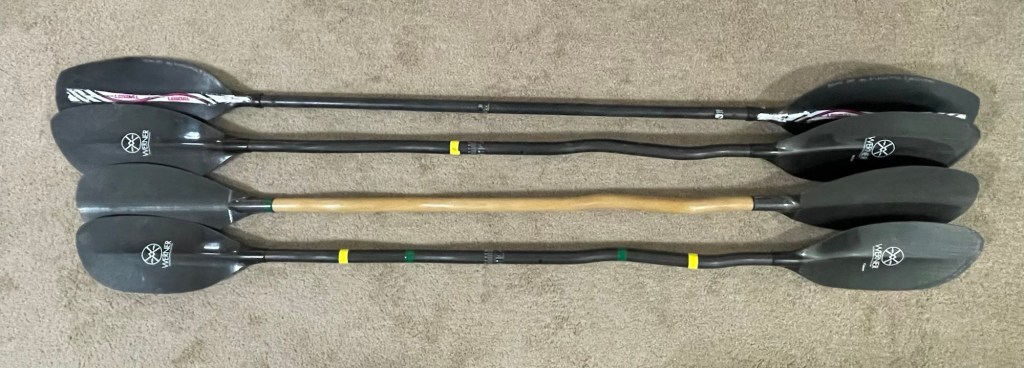
Charged-up by my discovery, I headed to the sales floor and started comparing the shaft lengths of all the paddles we had on the wall. High-angle, low-angle, and by all manufacturers. The results were illuminating.
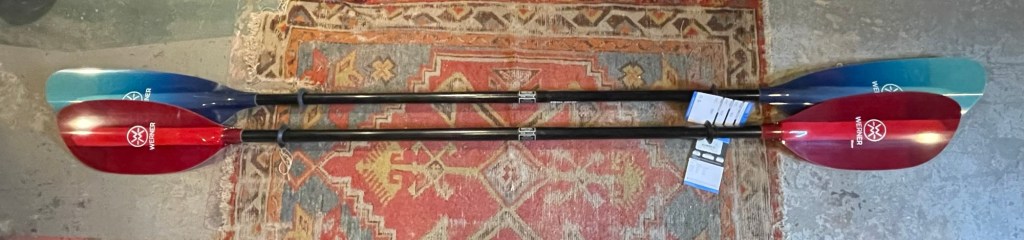
Shaft length varied widely across models and brands at any given overall paddle length. Some paddles, with long slender blades intended for low-angle paddling, had surprisingly short shafts. Short enough to make it difficult to use them with hands held low. Others had compact blades and long shafts. The overall length of the paddle seemed to have little relationship to the shaft length, regardless of which paddle I picked up.
Why shaft length matters
This is a problem because shaft length sets the angle of the paddle during the forward stroke. In the forward stroke, you want the blade of the paddle fully immersed without burying the shaft underwater.
This means a paddle with a longer shaft requires the blades placed farther from the centerline of the boat.
If you’re trying to keep your hands low, you need a long shaft to allow you to get the blade fully immersed at a low angle. If you’re trying to keep the blade close to the boat for a powerful forward stroke, you need a shorter paddle shaft.
You might expect longer paddle shafts would lead to longer paddles, and vice versa, but this isn’t always the case. Kayak paddle blades optimized for low-angle paddling are typically longer and narrower than those more suited to an upright stroke. High-angle paddle blades are usually wider and shorter.
If you’re choosing a paddle based on overall length, the difference in blade lengths can result in a wide variation in paddle shaft length.
It can also result in some confusing paddle length recommendations.
The other day I worked my way through an online paddle fitting exercise to see what size the manufacturer recommended for my height and boat width. When I compared the paddles recommended, I discovered the shaft of the low-angle paddle was actually shorter than the shaft of the high-angle model.
That doesn’t make any sense. The longer the shaft, the farther the blade will be from the side of the kayak when fully immersed. The farther away the paddle is, the lower the paddle angle to the water.
If all paddle blades were the same length, it would make sense to size paddles by overall length. They aren’t. Some blades are long; some are short. This means the current industry approach of sizing kayak paddles by overall length is wrong. It’s time for a better approach.
Through trial and error, I learned what length paddle shaft works best for me. When I’m shopping for a new paddle, I compare the length of the shaft to what I’m already using. I don’t pay much attention to the overall length. My paddle quiver contains paddles varying in total length, but they feel similar in the water, regardless of whether they are 205 or 215 centimeters long.
Once you know what length paddle you prefer, it’s easy to compare shaft lengths and pick a new paddle with a similar feel. But what about people who are just getting into the sport?
A New Way To Size Paddles
I think it’s time for paddle manufacturers to take a page out of the footwear playbook and create a paddle shaft sizing tool similar to the metal Brannock device ubiquitous in shoe shops and used to measure feet to determine shoe size. It wouldn’t be hard to do. All you need is an adjustable length paddle shaft with no blades on it. In the kayak shop, a customer could sit on the floor or on a low stool to simulate the paddling position in her kayak. She would then hold the kayak paddle sizer and shorten or extend the length until the lower end of the sizer touched the floor and her hands were in the appropriate position for forward paddling.
For an upright stroke, the sizer would be shortened until the top hand was at shoulder level and the paddle was at a high angle. For a lower stroke, the sizer would be lengthened until the hands could be held comfortably low.
Once the fitting tool has been adjusted, walk over to the paddle wall and compare the length of the sizer to the available paddles. Pick a model with blades appropriate for your preferred forward stroke and then select the size most closely matching the shaft fitter. Don’t worry about the overall length; it doesn’t matter much.
Creating a paddle shaft sizing tool seems like a straightforward way around the wide variation in paddle shaft length found in the marketplace. If such a tool were to be commonly used, I suspect we would discover many of the paddles sold over the past couple of decades have been the wrong size.
Trends in Paddle Length
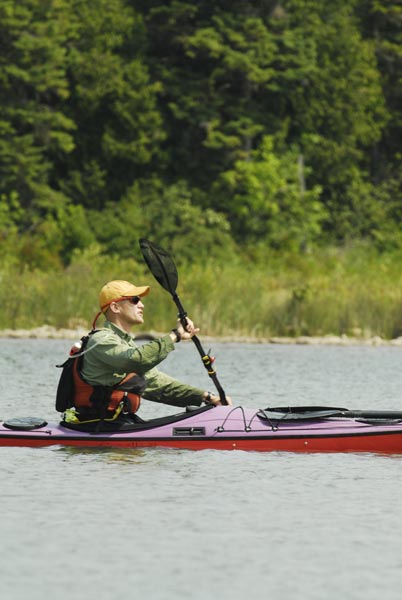
The kayak industry is in the midst of synthesizing the best influences from the Pacific Northwest and British sea kayaking traditions. Historically, paddles used in the West Coast style have been longer and more suited to a lower angle forward stroke. Those from the British style have tended to be somewhat shorter, likely because of the influence of training in whitewater kayaks before transitioning to sea touring in the UK. Whatever the reasons, the collision of these two schools of kayaking over the past 30 years has resulted in a squeezing of paddle sizes a bit toward the middle, mostly resulting in low-angle paddles getting shorter. And this doesn’t work.
If your paddle gets too short, you can’t use it with your hands held low. You’ll bang your knuckles on the boat. After you do this a few times you’ll naturally drift toward a more upright stroke that is appropriate for the shaft length of your paddle and you won’t be using the relaxed, low-angle stroke you had intended to use.
The paddle sizer is the solution to this problem.
What we’ll discover with widespread use of a paddle shaft sizing tool is low-angle paddle lengths will begin to trend longer again. Up over 230cm. 240 won’t be unusual.
I expect we’ll also see paddle lengths get shorter for high-angle forward paddling, as people discover the blades of some paddles call for much shorter shaft lengths than they had expected. Lengths for high-angle paddles will trend down toward 205cm. Or even 200.
Low angle paddles will get longer. High angle paddles will get shorter. And all kayakers will get a better fit.
If you enjoyed this post, please consider subscribing to Kitchi-Gami.com by using one of the links in the menu on the right side of the screen. On your mobile device you’ll find the links if you scroll to the bottom of the page. Thanks!
 Kitchi-Gami
Good article, well written. Great to hear your writing…..
Thanks Steve!
OK, not sure if my last comment went through or not but you deserve two ar least. Great article. I just got a response from Wenonah about the seat adjustment spring bar Lock mechanism. They mentioned you are not there anymore. I was sad to hear that and you will be missed as a most excellent point of contact and source of knowledge. I hope the move was a good one and that you and yours are happy, healthy, and prosperous. She mentioned you went “south” if you are near Atlanta and want to paddle sometime I would love to meet you. Thanks for everything.
Thanks! We’re in Savannah. I’m working with friends at Savannah Canoe and Kayak. Come on down!
That’s awesome. I spoke to those guys really early on when I was rebooting my paddling endeavor. I think they had a tfx Wilderness I thought I was intetested in. Im an hour north of ATL so thats about a 5 hour drive for me. We have been there with our rv 3 or 4 times if you count st Mary’s. It’s a beautiful area. Paddlers paradise for sure, or inshore fishing if you favor it.I will swing in and shake your hand the next time I am down that way.Thanks Again,AndySent from my Verizon, Samsung Galaxy smartphone
Thanks Andy. Look forward to seeing you the next time you’re down!